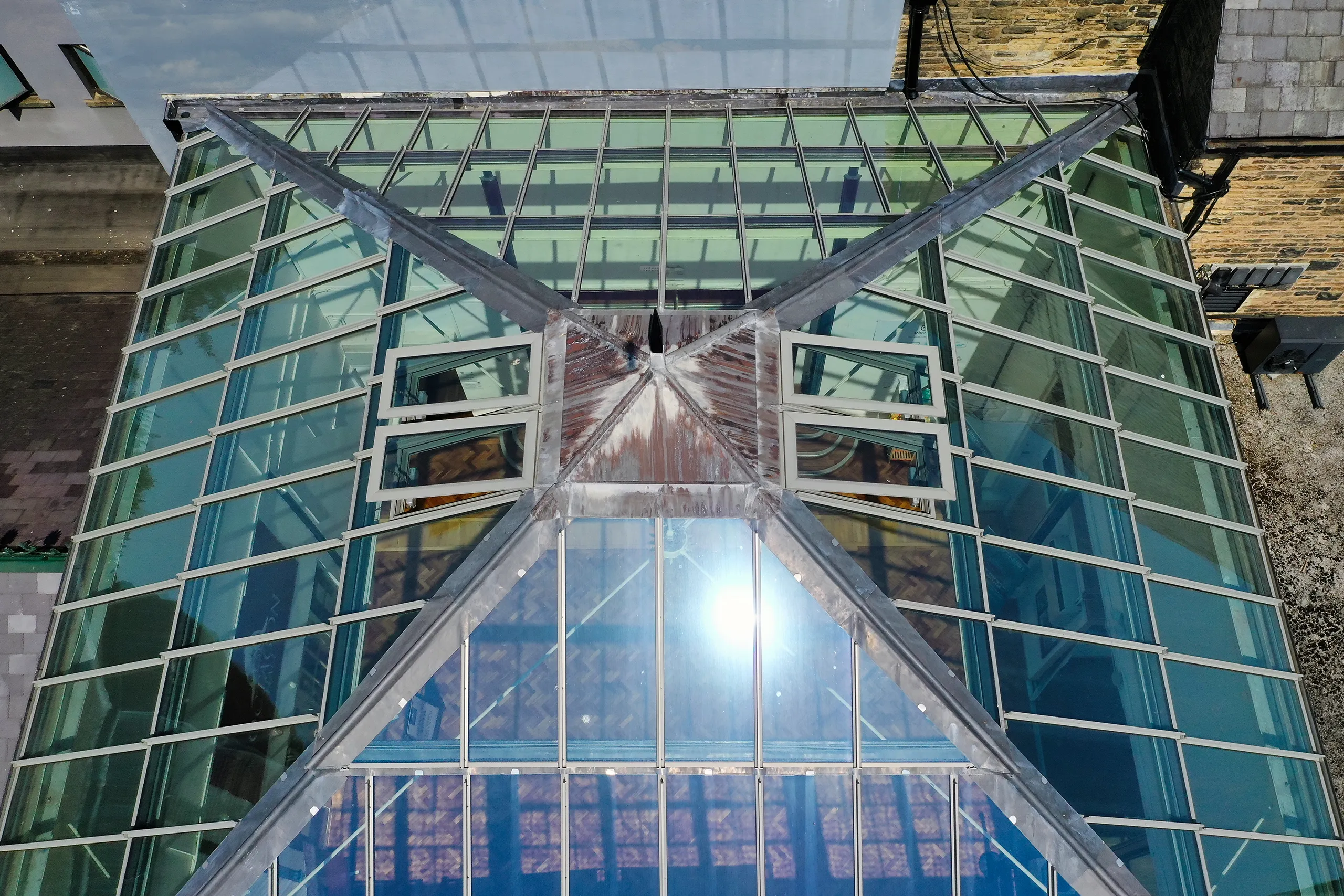
How to Manage Glass Thermal Stress: The Definitive Technical Guide
The physics of glass as a structural element is defined by a paradox: while it possesses immense compressive strength, its brittle nature makes it hypersensitive to internal tension. In the architectural sphere, this tension is most frequently induced by temperature differentials across a single pane. How to Manage Glass Thermal Stress. As one area of the glass expands under solar radiation while the edges remain cool within the frame, a tug-of-war begins at the molecular level. If the resulting force exceeds the modulus of rupture, the result is a characteristic crack—unpredictable, jagged, and often appearing with a suddenness that belies the slow accumulation of stress that preceded it.
Modern building design has exacerbated these vulnerabilities. The pursuit of highly insulated envelopes and the use of sophisticated solar-control coatings have fundamentally changed the energy absorption profiles of architectural glass. While a traditional monolithic pane might have allowed heat to pass through relatively unhindered, a modern high-performance unit is designed to trap and reflect energy. This intentional thermal management creates a high-stakes environment where the margin for error in edge treatment and framing clearances has narrowed significantly.
Addressing this complexity requires moving beyond a reactive stance. It is not enough to simply replace broken panes; one must master the systemic variables that dictate how heat is distributed across a facade. This pillar article provides an exhaustive examination of the mechanics of thermal tension, the influence of site-specific conditions, and the rigorous engineering protocols required to ensure the long-term integrity of the building skin. By synthesizing material science with practical site management, we establish a definitive framework for safeguarding the transparency of the built environment.
Understanding how to manage glass thermal stress
At its core, knowing how to manage glass thermal stress is about controlling the temperature gradient between the center-of-glass and the edge-of-glass. The edges of a glass pane are typically tucked into a framing system, which acts as a heat sink or is shielded from direct sunlight. When the sun strikes the center of the pane, that area heats up and expands. Because the edges are cooler and refuse to expand at the same rate, they pull back against the center. This creates tensile stress along the edge—the most vulnerable part of any glass unit.
A common misunderstanding in the field is the assumption that “heat-resistant” glass is a universal solution. While heat-strengthened or tempered glass can withstand higher differentials, they do not eliminate the stress; they merely raise the threshold of failure. If the underlying cause of the stress—such as deep shadows from an adjacent building or poorly placed interior blinds—is not addressed, even high-strength glass can eventually succumb to fatigue or spontaneous breakage due to localized “hot spots.”
Oversimplification risks are high during the planning phase. Professionals often rely on generalized charts that suggest a 50°F (10°C) differential is safe for annealed glass. However, these charts rarely account for edge-bite depth, the thermal conductivity of the framing material, or the presence of microscopic edge damage incurred during transport. A truly comprehensive approach requires a multi-perspective analysis that views the glass not as a standalone product, but as one part of a dynamic assembly involving the frame, the sealant, and the building’s interior micro-climate.
Deep Contextual Background: The Quest for Thermal Stability
The history of glass in architecture is characterized by a slow realization that glass is a “liquid” that acts like a solid. Early glass was so thick and irregular that thermal stress was often masked by the sheer mass of the material. However, as the 20th century brought perfectly flat, thin float glass, the industry began to see an uptick in mysterious “heat cracks.” The introduction of the “International Style” glass box in the mid-century forced a reckoning; buildings were now vast solar collectors, and the glass was the primary point of failure.
The 1960s and 70s saw the development of the heat-strengthening process, a middle ground between standard annealed glass and fully tempered safety glass. This period also introduced the first “Low-E” coatings. While these coatings revolutionized energy efficiency, they added a layer of complexity to thermal management. Because these coatings are designed to reflect infrared energy, they can actually increase the temperature of the glass substrate itself, creating higher internal differentials than the architects of the previous generation had ever encountered.
Today, we are in the era of high-opacity spandrel glass and triple-glazed units. We are no longer just managing sunlight; we are managing “energy traps.” The contextual background of modern glazing is one of balancing high-performance insulation with the physical limits of the material. As energy codes become more stringent, the tools we use to manage these stresses have evolved from simple “rules of thumb” to complex computer simulations that model the sun’s path across a facade to within a fraction of an inch.
Conceptual Frameworks and Mental Models
Navigating the variables of thermal tension requires mental models that simplify complex interactions without losing technical accuracy.
The Edge-to-Center Ratio
This framework focuses on the temperature delta. If the center of the glass reaches 140°F (60°C) and the edge remains at 70°F (21°C), the resulting stress can be calculated as a direct function of that 70-degree difference. Planners use this to decide whether a project can utilize standard glass or must upgrade to heat-treated options.
The “Shadow Casting” Matrix
Shadows are the primary cause of thermal stress. This model analyzes the type of shadow. A “clean” horizontal or vertical shadow is less dangerous than an L-shaped shadow or a diagonal shadow that cuts across a corner. Diagonal shadows create complex stress concentrations that are much harder for the glass to distribute.
The Heat Trap Framework
This model considers the space between the glass and the interior window treatment (blinds or curtains). If the gap is too small and the air is not ventilated, heat builds up in the cavity, re-radiating back into the glass. This “double-heating” effect can push even tempered glass to its limits.
Key Categories of Glass Resilience
When determining the best path for a project, the following categories define the hierarchy of resilience.
1. Annealed Glass
Standard glass cooled slowly to relieve internal stress.
-
Trade-off: Cost-effective and easy to cut vs. extremely low resistance to thermal differentials (roughly 35°F to 50°F max).
2. Heat-Strengthened Glass
Reheated and cooled faster than annealed glass, doubling its strength.
-
Trade-off: Excellent thermal resistance and remains in the frame if broken vs. not a “safety glass” (breaks into large shards).
3. Fully Tempered Glass
Rapidly cooled to create high surface compression, making it four to five times stronger than annealed glass.
-
Trade-off: Highest thermal resistance vs. prone to spontaneous breakage from nickel sulfide inclusions and cannot be cut or drilled after treatment.
4. Low-Iron Glass
Glass with reduced iron content, making it clearer.
-
Trade-off: Superior clarity and slightly lower solar absorption vs. higher cost.
Comparison of Thermal Performance
| Glass Type | Thermal Stress Tolerance | Fragmentation Pattern | Common Application |
| Annealed | Low | Large, sharp shards | Low-rise, low-sun exposure |
| Heat-Strengthened | Moderate | Large pieces (stays in frame) | Spandrel, high-wind zones |
| Fully Tempered | High | Small “dice” (safely falls) | Doors, low-level glazing |
| Laminated (Annealed) | Low | Stays bonded to interlayer | Soundproofing, security |
Real-World Scenarios and Decision Logic How to Manage Glass Thermal Stress
Scenario A: The Atrium with Deep Overhangs
A design features a massive glass atrium where the top half of the glass is permanently shaded by a structural overhang, while the bottom half is in direct sun.
-
Constraint: The permanent shadow creates a static thermal gradient.
-
Decision Logic: Annealed glass will almost certainly fail here. Heat-strengthened glass is required to manage the permanent tension at the shadow line.
Scenario B: The Black Spandrel Panel
A building uses black-painted glass (spandrel) to hide the floor slabs between windows.
-
Constraint: Black glass absorbs nearly 90% of solar energy.
-
Failure Mode: If the insulation behind the glass is placed too close, the heat has nowhere to go.
-
Decision Point: Spandrel glass must always be heat-strengthened or tempered to survive the 180°F+ temperatures it will reach.
Scenario C: Interior Blinds in a Desert Climate
An office in an arid climate uses heavy, dark-colored blackout blinds.
-
Constraint: The blinds absorb heat and reflect it back into the IGU (Insulated Glass Unit).
-
Second-order Effect: The inner pane of the IGU gets hotter than the outer pane, creating a “differential within a differential.”
-
Solution: The plan must include a minimum 2-inch clearance for the blinds and specify heat-treated glass for the inner lite.
Planning, Cost, and Resource Dynamics
Managing thermal stress is a front-loaded cost. The investment is made during the specification phase to avoid the “lagging cost” of replacement, which is often 5-10 times higher than the initial cost of the glass due to labor and site access.
Economic Impact of Strengthening
| Option | Upfront Cost Increase | Risk Reduction |
| Annealed to Heat-Strengthened | +15% to 25% | High (Reduces 80% of thermal risk) |
| Annealed to Fully Tempered | +25% to 40% | Very High (Reduces 95% of thermal risk) |
| Polished Edges (Standard) | Base | Baseline |
| Ground/Polished Edges (Premium) | +5% | Moderate (Removes micro-cracks) |
The opportunity cost of failing to manage these stresses is seen in building downtime and insurance premiums. A facade known for spontaneous breakage or thermal cracks becomes a liability that can decrease the valuation of a commercial asset.
Tools, Strategies, and Support Systems
-
Thermal Stress Analysis (TSA): A computerized simulation provided by glass manufacturers that calculates the probability of breakage based on site coordinates, glass type, and framing.
-
Edge Polishing: A mechanical process that removes the “flaws” left by the glass cutter. Smoother edges can handle significantly higher tension than “clean-cut” edges.
-
Heat Soaking: A destructive test for tempered glass where it is placed in an oven to force panes with impurities to break before they are installed.
-
Spectrally Selective Coatings: Coatings that block the heat (infrared) while letting in the light, reducing the overall heat load on the glass substrate.
-
Pressure-Equalized Framing: Ensuring that the glass is not “pinched” by the frame, which adds mechanical stress to the thermal stress.
-
Fritted Glass: Using ceramic patterns (dots or lines) to partially shade the glass, reducing the total energy absorption.
Risk Landscape and Failure Modes
Failure in the glass world is rarely about a single event; it is a “compounding risk” landscape.
-
Nickel Sulfide ($NiS$): A microscopic impurity that can exist in tempered glass. Over time, heat cycles cause it to expand, eventually exploding the glass from the inside out.
-
Edge Damage: A small “chip” on the edge of the glass reduces its strength by up to 50%. Thermal stress will find this chip and turn it into a full-length crack.
-
Thermal Shock: Not to be confused with gradual stress, this occurs when cold water (e.g., from a sprinkler or sudden rain) hits a sun-drenched pane, causing an instantaneous contraction that the material cannot accommodate.
Governance, Maintenance, and Long-Term Adaptation
Effective glass management requires a governance cycle that extends past the construction handover.
The Adaptive Maintenance Checklist
-
Pre-Season Inspection: Check for any new shadows created by new construction nearby or growing trees.
-
Interior Audit: Ensure tenants have not placed heaters, large furniture, or dark posters directly against the glass.
-
Sealant Review: Inspect the gaskets to ensure they haven’t hardened. Hardened gaskets prevent the glass from moving, which turns thermal expansion into physical pressure.
Adjustment Triggers
If a building experiences more than two thermal cracks in a calendar year, it should trigger a “topographical solar audit.” This determines if the building’s orientation or a specific interior condition is creating a systemic issue that necessitates a retrofit of the shading systems or a change in the HVAC flow.
Measurement, Tracking, and Evaluation How to Manage Glass Thermal Stress
-
Leading Indicators: The Solar Heat Gain Coefficient (SHGC) and the Center-of-Glass vs. Edge-of-Glass temperature delta predicted in the TSA.
-
Lagging Indicators: The “Breakage Rate” per 1,000 square feet of glazing over a five-year period.
-
Documentation:
-
The Thermal Analysis Report: The baseline document for why a specific glass was chosen.
-
Batch Certificates: Proving the glass was heat-soaked or strengthened according to ASTM standards.
-
Incident Logs: Detailed records of where and when a crack occurred (Time of day, temperature, shadow conditions).
-
Common Misconceptions and Oversimplifications
-
Myth: Double glazing is twice as strong.
-
Correction: It is twice as insulated, which actually increases the risk of thermal stress on the inner pane because heat gets trapped in the gap.
-
-
Myth: Cracks can be repaired.
-
Correction: A thermal crack in glass is structural. Once it starts, it will eventually travel to the other edge. The only solution is replacement.
-
-
Myth: Tinted film can be added to any window.
-
Correction: Adding aftermarket film to annealed glass in a sunny climate is the most common cause of “tenant-induced” thermal breakage.
-
-
Myth: “Safety Glass” is thermal glass.
-
Correction: Laminated glass is for safety (impact), but it is often made of annealed glass which is quite weak thermally.
-
-
Myth: Thick glass is better for thermal stress.
-
Correction: Thicker glass actually has more internal stress during temperature changes because the heat takes longer to travel through the material.
-
Conclusion: The Discipline of Durability
The transition from a vulnerable facade to a resilient one is found in the technical rigor of the planning phase. Mastery of how to manage glass thermal stress is a requirement for any professional tasked with the stewardship of a modern building. It is a discipline that demands an understanding of the sun’s path, the chemistry of polymers, and the brutal honesty of structural engineering.
In the end, glass is a material that rewards foresight. By respecting the molecular limits of the pane and designing with the assumption of movement, we create buildings that are not only beautiful but enduring. Transparency should not be equated with fragility; with the right frameworks in place, a glass facade can remain a clear and high-performing asset for the entirety of its intended lifespan.