Modern Glass Home Destinations USA: An Architectural Pillar Guide
The architectural fascination with the glass house in the American context is not merely a pursuit of aesthetic transparency, but a complex dialogue with the landscape and the limits of structural engineering. Since the mid-twentieth century, the glass-enveloped residence has served as a laboratory for the “International Style” and its contemporary successors, pushing the boundary between sheltered domesticity and the raw external environment. Modern Glass Home Destinations USA. To study these structures is to analyze a tension: the desire for total visual immersion versus the mechanical necessity of thermal regulation and privacy.
In the contemporary era, this dialogue has shifted toward high-performance sustainability. The modern glass home is no longer a fragile “fishbowl” vulnerable to the elements, but a sophisticated assembly of thermally broken frames, low-emissivity coatings, and laminated safety layers. These residences are increasingly concentrated in specific geographic corridors across the United States—regions where the topography demands a panoramic response and where local building cultures have evolved to support the specialized labor required for large-format glazing.
Navigating the landscape of these transparent icons requires an understanding of tectonic honesty. We must look past the superficial “modern” label and examine the systemic reality of these buildings. A glass house in the high desert of California faces fundamentally different structural and environmental stressors than a cantilevered glass volume in the Hudson Valley or a hurricane-resistant estate in the Pacific Northwest. This exploration serves as a definitive analysis of the primary regions, technical frameworks, and operational realities that define the most significant transparent residences in America today.
Understanding “modern glass home destinations usa”
To evaluate the modern glass home destinations usa, one must first decouple the “lifestyle” marketing from the architectural reality. A destination in this context refers to a geographic cluster where architectural innovation, local zoning permissiveness, and specialized glazing contractors converge. A common misunderstanding among observers is that any home with large windows qualifies as a “glass home.” In professional editorial circles, however, a true glass home is defined by its envelope-to-solid-wall ratio, where the glazing serves as the primary structural or metabolic skin of the building.
The risk of oversimplification lies in viewing these destinations through a purely aesthetic lens. For instance, the popularity of the “desert modern” aesthetic in Palm Springs is often attributed solely to the view. In reality, it is a product of specific advancements in overhang design and solar-tracking glass. Without these technical underpinnings, a glass home in the Mojave would be an uninhabitable oven. Therefore, a “destination” is as much a hub of engineering expertise as it is a scenic location.
Multi-perspective analysis also reveals a shift in the “privacy-transparency” paradox. Modern destinations are often located in remote or highly controlled environments—private canyons, coastal bluffs, or deep forest acreage. This isolation is a mechanical necessity for the glass home; it allows for the removal of traditional window treatments, enabling the architecture to function as intended. When we discuss these destinations, we are discussing a specific intersection of landscape architecture and fenestration technology.
Contextual Evolution: From the Fishbowl to the Filter
The historical trajectory of American glass homes is anchored by two mid-century pillars: Philip Johnson’s Glass House (Connecticut) and Mies van der Rohe’s Farnsworth House (Illinois). These were “mass walls” replaced by single-pane float glass. They were beautiful, but they were environmental failures—prone to condensation, massive heat loss, and a total lack of thermal control.
The systemic evolution of the last seventy years has transformed the glass wall from a passive sheet into an active filter. The introduction of the Insulated Glass Unit (IGU) in the late 20th century allowed for double and triple glazing, which introduced an insulating layer of argon or krypton gas. Today, we are in the era of “smart” glass and structural silicone glazing, where the metal frames are hidden or eliminated entirely, leaving only the transparent membrane. This evolution has expanded the map of where these homes can be built, pushing into climates previously considered too extreme for high-transparency architecture.
Conceptual Frameworks and Mental Models
1. The Threshold Dissolution Model
This framework measures the psychological and physical removal of the barrier between the inhabitant and the horizon.
-
Application: Homes utilizing zero-threshold tracks where the floor material continues seamlessly from interior to exterior.
-
Limit: High risk of water infiltration during extreme weather if drainage is not perfectly engineered.
2. The Biophilic Metabolic Framework
This evaluates the glass home as a tool for regulating human circadian rhythms through maximum exposure to natural light cycles.
-
Application: Prioritizing “low-iron” glass to ensure the truest color rendering of the natural environment.
3. The Thermal Inertia Paradox
This model addresses the lack of thermal mass in glass homes.
-
Application: Utilizing radiant floor heating and cooling to compensate for the glass’s inability to “store” heat like stone or brick.
Core Categories of Glass Residential Architecture
| Category | Typical Structural Strategy | Geographic Hubs | Primary Trade-off |
| The Desert Pavilion | Deep overhangs; solar-tinted glass | Palm Springs, AZ, NV | High cooling loads; UV damage |
| The Coastal Cantilever | Impact-rated glass; steel frames | Malibu, FL, PNW | Salt-air corrosion; wind-loading |
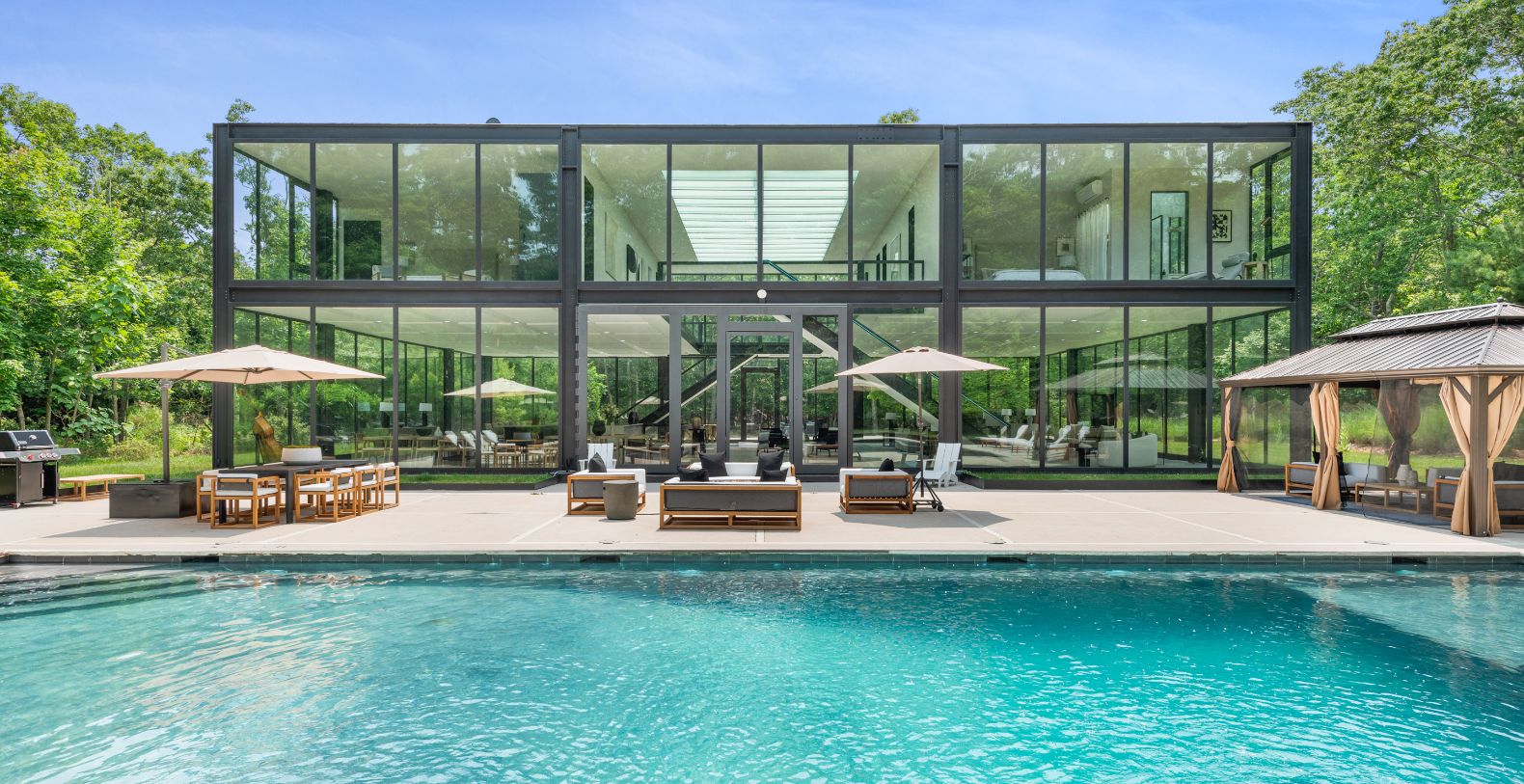
| The Forest Atrium | Clear low-iron glass; vertical fins | Hudson Valley, WA, OR | Privacy concerns; condensation |
| The High-Alpine Vista | Triple-pane; thermally broken | Aspen, Lake Tahoe, WY | Snow-load pressure; altitude stress |
| The Urban Glass Box | Acoustic laminates; mirrored films | LA, Miami, Austin | Noise pollution; heat island effect |
Analytical Real-World Scenarios Modern Glass Home Destinations USA
Scenario A: The Pacific Northwest Coastal Bluff
A residence features a 30-foot span of glass facing the Pacific Ocean.
-
The Conflict: The homeowner wants total transparency, but the site faces 100-mph wind gusts and salt-saturated air.
-
The Solution: An “Impact-Rated” system utilizing SentryGlas interlayers and “Coastal Grade” anodized aluminum frames.
-
Failure Mode: If the drainage “weep holes” are not cleaned, salt will build up, causing the secondary seal of the glass to fail, leading to permanent fogging.
Scenario B: The High-Desert Solar Sanctuary
A glass home in Joshua Tree with 360-degree views.
-
The Conflict: Extreme solar gain will fade interior furniture and overheat the space within minutes.
-
The Solution: Multi-focal Low-E coatings (specifically on the #2 and #4 surfaces) combined with automated exterior shading.
-
Second-Order Effect: The heavy tint required for heat control may distort the natural colors of the desert at sunset.
Planning, Cost, and Resource Dynamics
The economics of a modern glass home are dominated by the “Logistics of Transparency.”
| Budget Item | Range (Estimated) | Technical Reasoning |
| Engineering Fees | 8-12% of budget | Glass-to-steel connection calcs are complex. |
| Glazing Package | $250k – $1M+ | Includes high-performance coatings and gas fills. |
| Specialized Rigging | $15k – $50k | Large panes require vacuum lifts and cranes. |
| HVAC Integration | $50k – $150k | Oversized systems needed for glass loads. |
Tools, Strategies, and Support Systems
-
Structural Silicone Glazing (SSG): Eliminating visible metal by bonding the glass directly to the frame.
-
Vacuum Insulated Glass (VIG): The next frontier—achieving R-12 insulation in a unit no thicker than a single pane.
-
Motorized Sliding Tracks: Essential for moving 1,500-lb sliding doors with a single button.
-
Acoustic Laminates: Using specialized PVB interlayers to block street noise while maintaining clarity.
The Risk Landscape and Failure Modes
-
Thermal Stress Breakage: When a pane is partially shaded while the rest is in direct sun, creating a temperature differential that “tears” the glass.
-
Edge Delamination: In coastal destinations, moisture can creep into the edges of laminated glass, causing a “milky” haze.
-
Spontaneous Breakage: Usually caused by Nickel Sulfide inclusions in tempered glass—a microscopic impurity that expands over time.
-
Hardware Fatigue: In massive sliding systems, the rollers are the weak point; if they flat-spot, the door becomes immobile.
Governance, Maintenance, and Long-Term Adaptation
A glass home is a “high-maintenance” asset that requires a governance protocol.
-
Annual Track Service: Removing grit from the stainless steel tracks to prevent bearing failure.
-
Bi-Annual Sealant Audit: Inspecting the silicone joints for UV degradation or “chalking.”
-
Bird-Safe Retrofitting: As migratory patterns shift, adding UV-reflective markers may be necessary to prevent bird collisions.
Measurement, Tracking, and Evaluation
-
U-Value Tracking: Using thermal cameras to ensure the “thermally broken” frames are actually preventing heat transfer.
-
SHGC Verification: Monitoring the interior temperature on a “Peak Sun” day to evaluate if the coatings are performing as modeled.
-
Deflection Logging: Measuring the “center-of-glass” movement during high wind events to ensure it stays within safety tolerances.
Common Misconceptions
-
Myth: “Glass homes are inherently unsafe during storms.”
-
Correction: With modern lamination, glass can be stronger and more resilient than traditional plywood and siding.
-
-
Myth: “All glass is the same.”
-
Correction: The difference between standard “Clear” glass and “Low-Iron” glass is the difference between a green-tinted view and an invisible one.
-
-
Myth: “You can’t have privacy in a glass home.”
-
Correction: Strategic landscaping, “smart” switchable glass, and directional orientation provide total privacy without curtains.
-
Conclusion
The evolution of modern glass home destinations usa represents a triumph of material science over the vulnerabilities of the domestic envelope. By treating glass as a dynamic structural and environmental filter, architects have opened up the American landscape to a new form of high-performance living. Success in this field is not measured by the size of the window, but by the intelligence of the system that supports it. As we move toward a future of carbon-neutral transparency, these homes will serve as the definitive benchmarks for how we coexist with the environment without surrendering the comforts of the interior.