Best Glass Roof for Greenhouse: The Definitive Engineering Guide
Selecting the best glass roof for greenhouse construction is an exercise in balancing opposing forces: light transmission versus thermal insulation, structural weight versus architectural elegance, and initial capital expenditure versus long-term operational viability. For the serious horticulturalist or the estate manager, the roof is not merely a lid; it is the primary engine of the greenhouse. It dictates the photosynthetic potential of the environment while serving as the first line of defense against atmospheric volatility.
The complexity of modern glass engineering has moved the conversation far beyond simple panes of horticultural glass. Today, a high-performance roof must account for solar heat gain coefficients (SHGC), U-values, and the structural integrity required to withstand localized snow loads and wind shear. This guide treats the glass roof as a sophisticated membrane—a filtered interface between the internal microclimate and the external environment.
To identify the most suitable glazing solution, one must look past marketing generalities. The “best” option is rarely a single product; it is a configuration tailored to the specific intersection of latitude, plant typology, and local climate. This analysis deconstructs the engineering and horticultural logic required to build a structure that remains efficient and stable over several decades.
Understanding “best glass roof for greenhouse”
The search for the best glass roof for greenhouse applications often suffers from a reductive focus on transparency. In the context of professional horticulture, “best” is a multidimensional metric. It implies a material that manages the light spectrum effectively while minimizing the energy required to maintain a set point temperature. A common misunderstanding is that more light is always better; however, without proper diffusion or UV management, excessive light can lead to photoinhibition or scorching.
Oversimplification in this sector usually involves ignoring the weight of the glass. A high-performance triple-glazed unit offers exceptional insulation but demands a heavy-duty aluminum or steel substructure that may significantly increase the total project cost. Therefore, the “best” roof is the one where the glazing properties align with the structural capacity of the frame and the biological needs of the flora within.
Furthermore, the term encompasses safety. Standard annealed glass, while traditional, poses a significant risk in modern settings. The industry has shifted toward tempered (toughened) and laminated variants. These are not merely luxury upgrades; they are foundational requirements for any structure intended for long-term use in areas prone to hail or falling debris.
Deep Contextual Background
Historically, greenhouse glazing was limited by the size of the glass panes that could be manufactured. The Victorian era saw the rise of the “great conservatories,” which utilized small, overlapping panes of hand-blown glass. While aesthetically striking, these structures were notoriously drafty and inefficient.
The mid-20th century brought the advent of float glass, allowing for larger, more uniform sheets. This revolutionized greenhouse design, leading to the “Venlo” style and other commercial archetypes that prioritized maximum light entry. However, these early large-pane designs often struggled with heat loss.
In the contemporary era, the focus has shifted toward “smart” coatings and gas-filled cavities. The evolution from monolithic glass to Insulated Glass Units (IGUs) represents a systemic change in how we view the greenhouse. It is no longer just a “sun catcher”; it is a thermal battery. The integration of Low-E (low-emissivity) coatings marks the latest frontier in making year-round glass cultivation economically viable in cold climates.
Conceptual Frameworks and Mental Models
To navigate the selection process, it is helpful to apply specific frameworks that weigh technical specs against practical outcomes.
The Thermal-Optical Trade-off
This model suggests that as you increase the thermal resistance (R-value) of a glass roof through extra layers or coatings, you inevitably decrease the Visible Light Transmission (VLT). The goal is to find the “sweet spot” where the loss in light is offset by the savings in heating or cooling energy.
The Lifecycle Integrity Model
A glass roof should be evaluated by its Year 20 performance. Unlike polycarbonate, which yellows and becomes brittle due to UV exposure, glass is chemically inert. If the seal fails in an IGU, the “best” glass becomes a liability due to internal condensation.
The “Dynamic Load” Framework
This considers the glass as a component subject to live loads like snow and wind. The choice of thickness and tempering must ensure the glass acts as a structural diaphragm rather than just a filler.
Key Categories and Variations
1. Horticultural Float Glass
The entry-level standard. It is clear and allows high light transmission but lacks strength. It breaks into large, sharp shards, making it less ideal for high-traffic areas or regions with extreme weather.
2. Tempered (Toughened) Glass
Processed through extreme heating and rapid cooling, this glass is 4–5 times stronger than standard float glass. When it breaks, it disintegrates into small, relatively harmless granules.
3. Diffused Glass
A specialized glass with a matte or textured surface that scatters incoming light. This prevents “hot spots” and ensures light reaches the lower leaves of dense canopies, often increasing crop yields by 5–10%.
4. Low-Emissivity (Low-E) Glass
Features a microscopically thin coating of metal oxide. In winter, it reflects heat back inside; in summer, it reflects solar heat outward. It is essential for greenhouses attached to homes.
5. Laminated Glass
Consists of two layers of glass with an interlayer of plastic (PVB or SGP). Even if the glass breaks, the shards remain adhered to the plastic. This is the gold-standard for overhead safety.
6. Insulated Glass Units (IGUs)
Double or triple-paned units filled with argon or krypton gas. While they provide superior insulation, they are heavy and require precise installation to prevent seal failure.
Comparison of Glazing Performance
| Glass Type | Light Trans. | Insulation (U-Value) | Durability | Safety Rating |
| Horticultural | 90-92% | High (Poor) | Low | Low |
| Tempered (Single) | 90-91% | High (Poor) | High | Medium-High |
| Diffused | 85-90% | High (Poor) | High | Medium |
| Double IGU (Low-E) | 70-80% | Low (Excellent) | High | High |
| Laminated | 86-88% | Moderate | Very High | Maximum |
Detailed Real-World Scenarios Best Glass Roof for Greenhouse
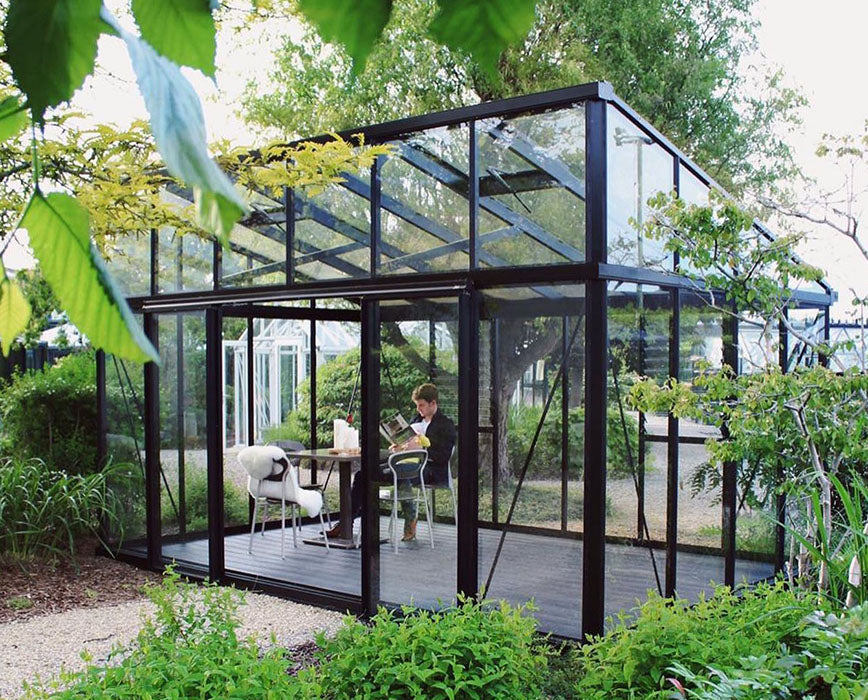
Scenario A: The High-Altitude Alpine Greenhouse
In environments with heavy snow and intense UV, a single-pane glass roof is insufficient. The strategy involves a 6mm tempered outer pane with a laminated inner pane, separated by an argon-filled gap. This provides the structural strength for snow loads and the insulation needed for sub-zero nights.
Scenario B: The Urban Attached Conservatory
When the greenhouse shares a wall with a living space, the glass roof must behave like a residential window. High SHGC can lead to overheating the house. The strategy involves Low-E coatings and perhaps a tinted interlayer in the laminated glass to manage glare and heat.
Scenario C: The Tropical Orchid House
Here, light diffusion is more critical than insulation. Direct sun can burn sensitive epiphytes. The “best” choice is a high-haze diffused glass. This eliminates shadows from the greenhouse frame and ensures a uniform light environment.
Planning, Cost, and Resource Dynamics
The financial planning for a glass roof involves more than the price per square foot. There is a significant “opportunity cost” associated with cheaper glazing: higher energy bills and potential crop loss.
Direct and Indirect Costs
-
Material: $15–$60 per square foot depending on complexity.
-
Logistics: Shipping costs and specialized crane rentals for installation can add 20% to the project budget.
-
Structural Reinforcement: Moving from 3mm to 6mm glass often requires 30% more aluminum in the rafters.
Estimated Cost Range for 12x18ft Greenhouse Roof
| Component | Basic Tempered | High-Performance IGU | Premium Laminated/Diffused |
| Glass Units | $2,500 – $4,000 | $8,000 – $12,000 | $15,000 – $22,000 |
| Framing/Seals | $1,500 – $3,000 | $4,500 – $7,000 | $6,000 – $9,000 |
| Installation | $2,000 – $4,000 | $5,000 – $8,000 | $7,000 – $10,000 |
| Total Est. | $6,000 – $11,000 | $17,500 – $27,000 | $28,000 – $41,000 |
Tools, Strategies, and Support Systems
-
Automated Shading Systems: Essential for glass roofs to prevent summer overheating. External rollers are more effective than internal ones.
-
Thermal Breaks: In the framing system, these prevent heat from “wicking” out through the metal rafters.
-
Condensation Channels: Integrated channels in the rafters carry moisture away to prevent dripping on plants.
-
Capping Systems: High-quality EPDM gaskets and aluminum caps ensure the glass remains watertight.
-
Desiccant Spacers: In IGUs, these absorb any residual moisture in the air gap to prevent fogging.
-
Structural Silicone: Used in “frameless” or “seamless” designs to provide a weather-tight seal while allowing for slight glass movement.
Risk Landscape and Failure Modes
The primary risk to a glass roof is Seal Failure in multi-pane units. Once the hermetic seal is compromised, moisture enters the cavity, creating a permanent fog. This is often caused by poor drainage in the glazing rebate.
Thermal Stress Cracking occurs when one part of a glass pane becomes significantly hotter than another. This is more common in tinted or thick glass and can be mitigated by heat-strengthening the material.
Spontaneous Breakage in tempered glass, often caused by nickel sulfide inclusions, can be a catastrophic failure. Heat-soak testing is a secondary process that can identify at-risk panes before they leave the factory.
Maintenance and Long-Term Adaptation
A glass roof is a 30-year asset, but only if maintained.
-
Bi-Annual Cleaning: Soot and dust can reduce light transmission by up to 10% per year if left unchecked.
-
Gasket Inspection: EPDM gaskets can dry out or shrink over a decade. Checking for “creeping” gaskets prevents leaks.
-
Sealant Replacement: Perimeter structural silicones typically have a 15–20 year lifespan.
Measurement, Tracking, and Evaluation
-
Leading Indicator: Daily PAR (Photosynthetically Active Radiation) readings inside vs. outside.
-
Lagging Indicator: Monthly heating/cooling KWh usage per square foot.
-
Qualitative Signal: Condensation patterns on the interior of one specific pane suggests a local insulation failure.
Common Misconceptions and Oversimplifications
-
“Glass is always colder than polycarbonate.” A double-paned Low-E unit can actually outperform multi-wall polycarbonate in heat retention.
-
“Tempered glass is unbreakable.” It is strong against surface impact but vulnerable at the edges.
-
“UV light is essential for all plants.” Many plants thrive with filtered UV; excessive UV can degrade plastic components.
-
“Weight doesn’t matter for the foundation.” A glass roof can weigh 4-5 times as much as a plastic one.
-
“Self-cleaning glass is maintenance-free.” It requires sunlight and rain to work. In dry spells, it still needs manual washing.
Synthesis and Final Editorial Judgment
The best glass roof for greenhouse applications is defined by its ability to disappear—both aesthetically and functionally—into the operational rhythm of the structure. For most high-end residential and professional applications, the optimal configuration is a 4mm or 6mm tempered, diffused glass for single-layer applications, or a tempered/laminated IGU with a Low-E coating for year-round climate control.
The decision must be rooted in the specific light requirements of the crop and the cost of energy in the local region. While the initial investment in premium glazing can be daunting, the longevity and clarity of glass provide a stable environment that alternative materials cannot match.